AfD victory in Saxony-Anhalt spurs Weidel on and alerts Merz
On 6 September, the far-right party AfD (Alternative for Germany) achieved 43.8% of Saxony-Anhalt's votes, making them just three seats short of a majority in state parliament.
Whilst far-right politicians and entrepreneurs including Elon Musk have rejoiced, Chancellor Merz, Germany’s current Head of Government, has said it ‘changes all of Germany’.
The AfD is the only major far-right party within Germany and have received series of accusations, most notably Chancellor Merz’s questioning of the party's ties to Russia.
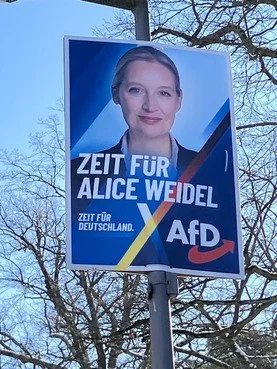
Similarly, Alice Weidel, co-leader of the AfD, has been scrutinised by the press. Firstly, in an interview with Politico, Weidel criticised modern German education for focusing on Nazi crimes, arguing it is a ‘guilt cult’.
When questioned as to why she used the term ‘guilt cult’, a term originating in Neo-Nazi propaganda, she stated, ‘I don’t care where the word comes from’.
Weidel commented on the victory on 7 September, saying that the AfD had resisted the ‘firewall’ promulgated by other German political parties. The ‘firewall’, as Weidel visualised it, refers to the informal commitment by other German parties to never make coalition governments with the far-right party.
Another reason for the ‘shock’ of the electoral victory of the AfD in Saxony-Anhalt lies within the state’s voting history. For 24 years, the Christian Democratic Union (CDU) had ruled the state. However, the votes now convey a new power balance between the CDU and the AfD.
Yet, the victory of the AfD in Saxony-Anhalt hasn’t developed smoothly in the wider community.
Speaking to DW News, Gökay Sofuoglu, who is the co-chair for the Turkish Community in Germany, conveyed how Turks in Germany are increasingly anxious over the AfD’s policies.
Many of them who own local businesses have considered ‘shutting up shop and leaving, first Saxony-Anhalt, then Germany’
Also, this fear of racial persecution has been actualised already. On the election day, Alaa Agha, a 55-year-old Syrian woman who became a German citizen, faced an incident of verbal racism.
The unidentified man yelled at her to ‘Go back to your own country’.
Agha later spoke about experiences of having stones thrown at her and being spat at due to her appearance.
As reported by Jon Henley, a quarter of European voters cast their votes for populist parties, including both far-left and far-right groups. Henceforth, the AfD’s victory in Saxony-Anhalt conveys a notable trend. Specifically, the party’s success highlights the historic rise of far-right parties being voted in national elections.
Currently, no AfD government in Saxony-Anhalt has been formed, likely due to the ‘firewall’. In the coming days, the AfD may either ally with another populist party or hold a minority government in the state.
Home page featured image “Valgplakat fra valgkampen til Forbundsdagen i 2025” by Peter Nedergaard is licensed under CC BY-SA 3.0.
