9/11: The Crisis that Robbed the Dollar

On Tuesday 11th September 2001, many commuted to the bustling streets of New York, only to realise that a series of coordinated terrorist attacks would unfold on their journey… The iconic phrase, “9/11” emphasises the specific date this tragedy commenced, sending shockwaves across the globe – not just in the downtown US city…
Al-Qaeda lead a team in a national heist, hijacking four commercial airplanes and crashing them into the World Trade Centre in New York City and the Pentagon near Washington D.C. The team consisted of 19 terrorists who spread themselves out amongst the 4 aircrafts, planning to target attention on the US government. The fourth plane, Flight 93, ended up crashing into a field in Pennsylvania after passengers fought back against the hijackers, essentially saving the lives of the passengers in the plane’s intended destination, which was either the U.S. Capitol building or the White House, both in Washington D.C.
These devastating attacks resulted in the deaths of 2,977 people, with thousands more injured. But why did these events occur in the first place? There is a short answer: Al-Qaeda.
Al-Qaeda is an international Islamist extremist terrorist network founded in the late 1980s by Osama Bin Laden – who was targeted and killed as a result of the 9/11 attacks in a U.S military operation on May 1st, 2011 – as well as others who were involved in the war against the Soviet Union in Afghanistan. Their aim remains to overthrow governments in the Middle East, and elsewhere in the Islamic world, which do not strictly enforce a religiously sanctioned political and social order. Attacks against the United States were intended to reduce American support for many of these governments; U.S. support was viewed by al-Qaeda as a major obstacle to creating a global order under Islamic Authority.
They have claimed responsibility for numerous terrorist attacks since the early 1990s, including the 1998 U.S. Embassy bombings in Kenya and Tanzania, the 2000 attack on the USS Cole, and the 9/11 attacks. They have also inspired and aligned themselves with other terrorist groups who have carried out attacks, including the 2002 Bali bombing, the 2004 Madrid train bombing, the 2005 London bombings, and the 2008 Mumbai terrorist attacks, among many others.
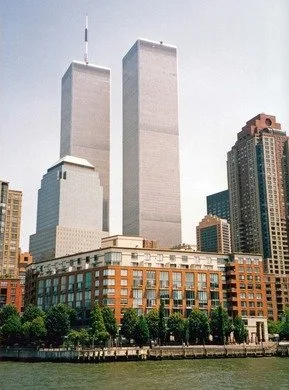
The terrorists did not have the capacity to destroy the United States in terms of military operations, so they set their sights on symbolic targets. The Twin Towers, as the centrepieces of the World Trade Centre, primarily symbolised globalisation and America’s economic power and prosperity.
The Pentagon, as the headquarters for the U.S. Department of Defence, serves as a symbol of American military power. It is thought that Flight 93, the plane that was heroically overtaken by brave passengers, was headed to the Capitol building, the centre of American legislative government.
Al-Qaeda hoped that, by attacking these symbols of American power, they would instil fear across the country and severely weaken the United States’ standing on the world stage of development, ultimately helping to achieve al-Qaeda’s own political and religious goals in the Middle East and Islamic world.
U.S stock markets closed for four days after the attacks. Once reopened, the Dow Jones Industrial Average fell 7.1% (684 points) on the first day of trading, a record loss then. Stock prices in European and Asian markets also retreated. Not unexpectedly, airlines and insurance companies were the most severely and immediately affected. The global tourism industry registered a contraction of 1.0% in its contribution to world GDP in 2001, against a previously projected 3.0% growth. Oil prices were volatile due to concerns about supply stability in the Middle East, while non-fuel commodity prices dropped. Globally, nations strengthened anti-terrorism legislation and expanded the powers and budgets of law enforcement and intelligence agencies, leading to significant new costs for global security, and especially airport security. Moreover, the attacks directly led to the United States’ ‘War on Terror,’ encompassing the wars in Afghanistan and Iraq, which have had massive ongoing economic costs for the U.S, and significant, lasting consequences for the global geopolitical and economic landscape.
The 9/11 Memorial opened on September 11, 2011, the 10th anniversary of the attacks. It is located on the western side of the former World Trade Centre complex where the Twin Towers once stood. The Memorial was designed by two architects, Micheal Arad and Peter Walker, whose proposal was selected in a design competition out of 5,201 submissions from 63 countries.
The Memorial Plaza surrounds two enormous reflecting pools within the footprints of the North and South Towers. This is where the towers used to stand. The pools feature 30-foot waterfalls – the largest man-made waterfalls in North America. The water cascades into reflecting pools, finally disappearing into the centre voids. The names of people who were killed in the 9/11 attack in New York, at the Pentagon, and on Flight 93, as well as in the 1993 bombing at the WTC, are etched in bronze around the edges of the pools.
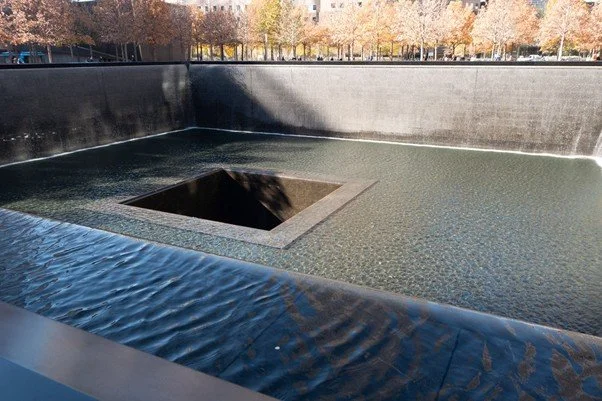
The plaza is lined with cobblestone, and has more than 400 swamp white oak trees, creating a space for reflection separate from the sights and sounds of the surrounding city. The trees were selected from within a 500-mile radius of the WTC site, including nurseries located in New York, Pennsylvania, and near Washington, D.C, to symbolise areas impacted on 9/11.