Salisbury Cathedral: A Masterpiece of Early English Gothic Architecture
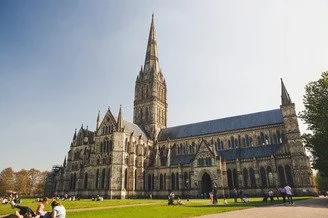
If you approach Salisbury Cathedral across the Close, something quietly remarkable happens. The landscape opens, the grass stretches wide, and the immense spire rises into the sky with a sense of steady calm. Unlike many cathedrals crowded into medieval streets, Salisbury stands alone, almost floating within its own green world, where over 800 years of history sit folded into a single space.
Salisbury Cathedral is not only visually striking; it is a work of architecture that expresses a harmony of intention - of height, light, craftsmanship, and human aspiration - all built within an unusually short period of time. While most European cathedrals took centuries to complete, adapting to changing styles and political circumstances, the main body of Salisbury Cathedral was built between 1220 and 1258, in just 38 years. As a result, the nave, transepts, choir, and cloisters (a covered walkway that forms a quadrangle) all share a unified architectural language: Early English Gothic.
Gothic architecture originated in France, in buildings such as the Basilica of Saint-Denis and Notre-Dame de Paris. French Gothic is often characterised by dramatic verticality and an intense upward pull, designed to overwhelm the viewer with height and light. English Gothic, however, developed a different emphasis. It favours horizontality, long perspectives, balance, and clarity. Rather than creating spectacle, it creates calm.
Salisbury Cathedral is widely regarded as the purest surviving example of Early English Gothic. Given that fact it was constructed so quickly, it possesses an unusually coherent identity. This sense of unity is central to its beauty and has made Salisbury an important reference point for architects and historians alike.
Although Gothic architecture began in the Middle Ages, it was passionately revived in the 19th century. The Gothic Revival movement was led by figures such as Augustus Pugin and Sir Charles Barry, who designed the Houses of Parliament. They believed that medieval Gothic principles embodied moral and aesthetic values that had been lost in post-Reformation England. Salisbury Cathedral, with its clarity and restraint, became an important model for this revival.
Inside the cathedral, the first aspect anyone can notice is one of lightness. Early English Gothic is defined by pointed arches, tall slender columns, and ribbed vaults that appear almost weightless. Rather than relying on elaborate decoration, the architecture depends on proportion, rhythm, and spatial clarity.
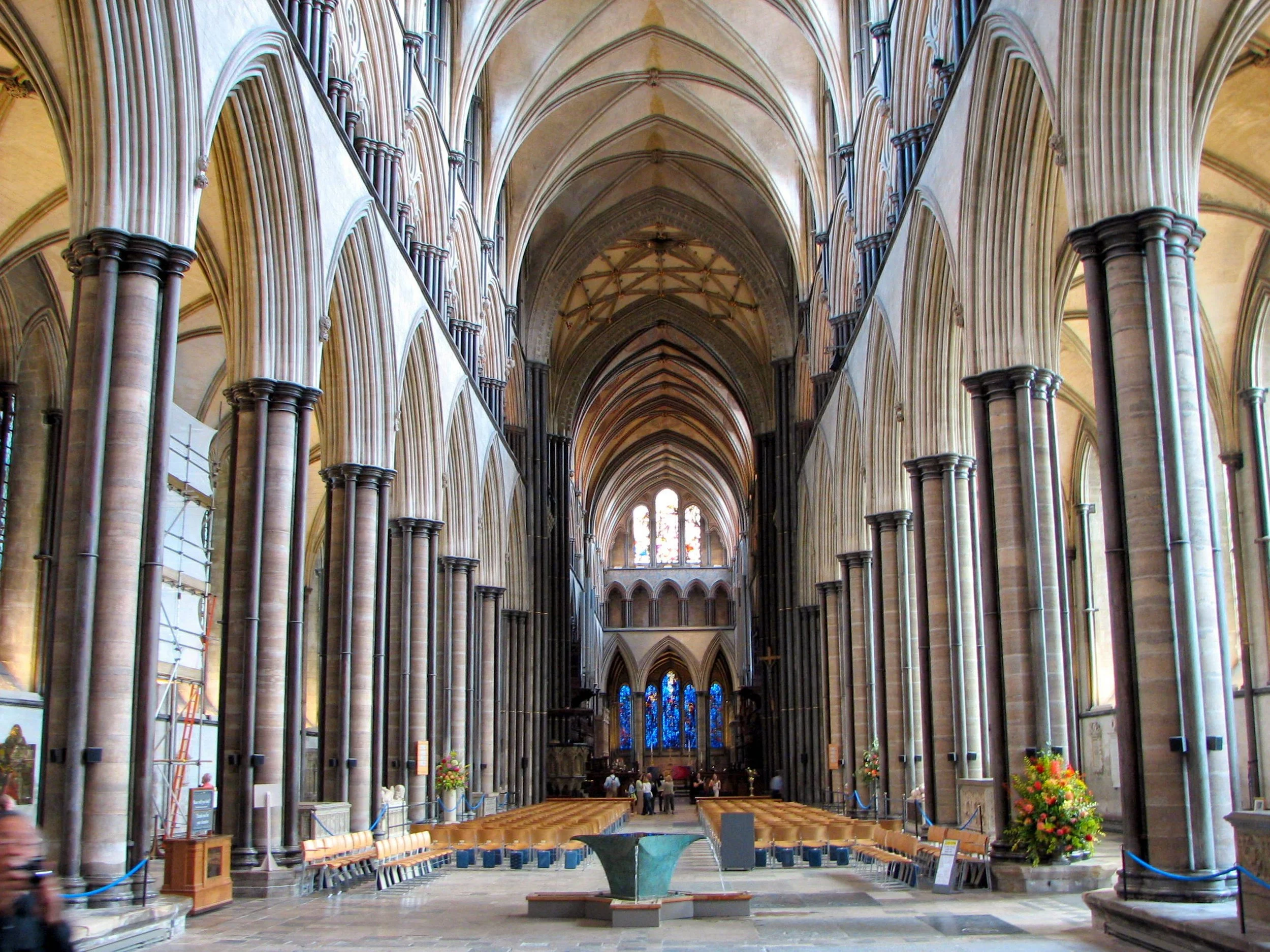
This sense of rhythm is especially evident in the cathedral’s geometry. Every arch, rib, and column participates in an ordered sequence. The clustered piers rise vertically, break into ribs, and meet in vaults with elegant intersections. The effect is not rigid, but fluid - more like a pulse or a breathing pattern. Harmony is a key to Gothic architecture, and at Salisbury, this harmony feels almost musical, as if the architecture resolves itself naturally.
One feature that reinforces this idea of order is the cathedral’s famous clock, believed to be the oldest working mechanical clock in the world, dating from around 1386. Unlike modern clocks, it has no face; it was never meant to be seen, but heard. Its bell structured daily life, and represents the evolution of time. The clock symbolises Gothic ideas of order and harmony.
Perhaps the cathedral’s most striking feature is its spire. Rising to 123 metres, it is the tallest in Britain - and incredibly, it was not part of the original design. Added around 1320, the spire is a remarkable feat of medieval engineering.
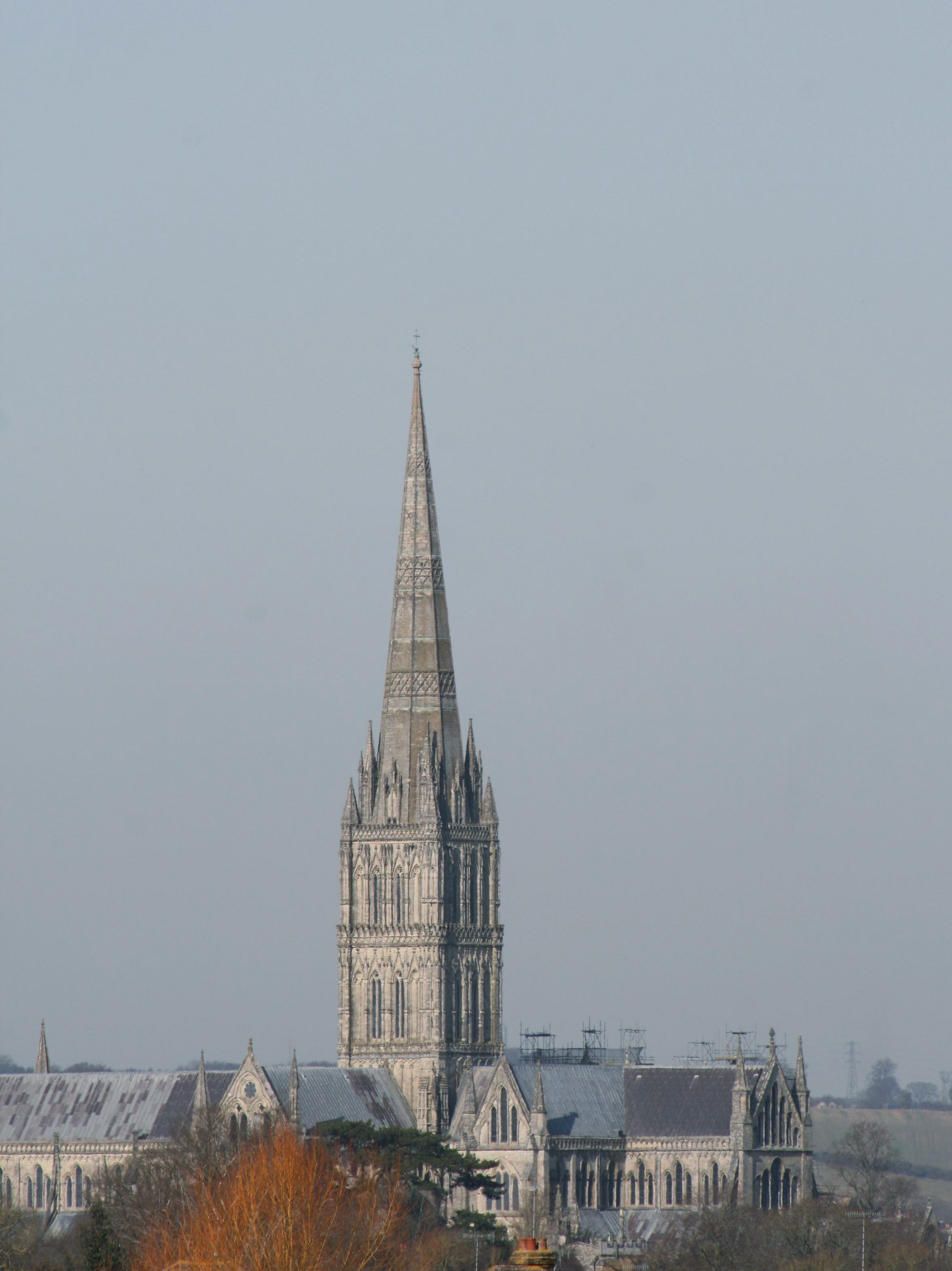
Considering how the foundations were never intended to support such height, craftsmen reinforced the interior with arches, bracing, and hidden structural supports. Weighing approximately 6,400 tonnes and resting on foundations only a metre deep, the spire has required careful reinforcement throughout its history.
Yet what is most remarkable is not just the technical challenge, but how naturally the spire complements the building. Where many spires feel forceful or triumphant, Salisbury’s rises with extraordinary gentleness. It does not pierce the sky so much as grows toward it, completing the cathedral’s upward gesture and reinforcing its central idea: architecture as aspiration.
The cloisters, the largest in Britain, reveal another dimension of English Gothic. Their repeating arches surround a central lawn, creating a balance between enclosure and openness. Walking through them feels almost meditative, as the steady rhythm of the arcades produces a sense of tranquillity.
Nearby, the Chapter House forms an octagonal space supported by a single slender column - an extraordinary feat of balance and grace. It is home to one of the surviving original copies of the Magna Carta, a document that has shaped legal systems around the world. Around the walls, a carved stone frieze (a long narrow strip of decoration along a wall) narrates scenes from the Old Testament in vivid detail, reflecting the medieval love of storytelling. Here, architecture becomes communal, narrative, and deeply human.
Light is perhaps the cathedral’s defining quality; Salisbury is filled with gentle luminosity. Narrow lancet windows allow thin blades of daylight to descend along the stone. As the day progresses, light moves across columns and softly warms the floor. Gothic architecture here is not only an engineering achievement, but a meditation on light as a symbol of clarity, hope, and revelation.
Salisbury Cathedral is more than a masterpiece of Early English Gothic. It is a unified vision - a building that shows how architecture can be both structure and symbol, engineering and emotion. It feels complete, not because it is more ornate than others, but because its ideas are balanced. The unity of style, the play of light, the rise of the spire, and the calm of the cloisters work together to create a space that is both grounded and aspiring.
Ultimately, the cathedral expresses something profoundly human: the desire to build not only upward, but inward - toward meaning, harmony, and a sense of order that continues to resonate centuries later.
